




Research

Pilot Study

Character Education Program Pilot Report

Needs analysis, implementation, and initial findings from the NEA-funded JourneyLand Character Education Program pilot.

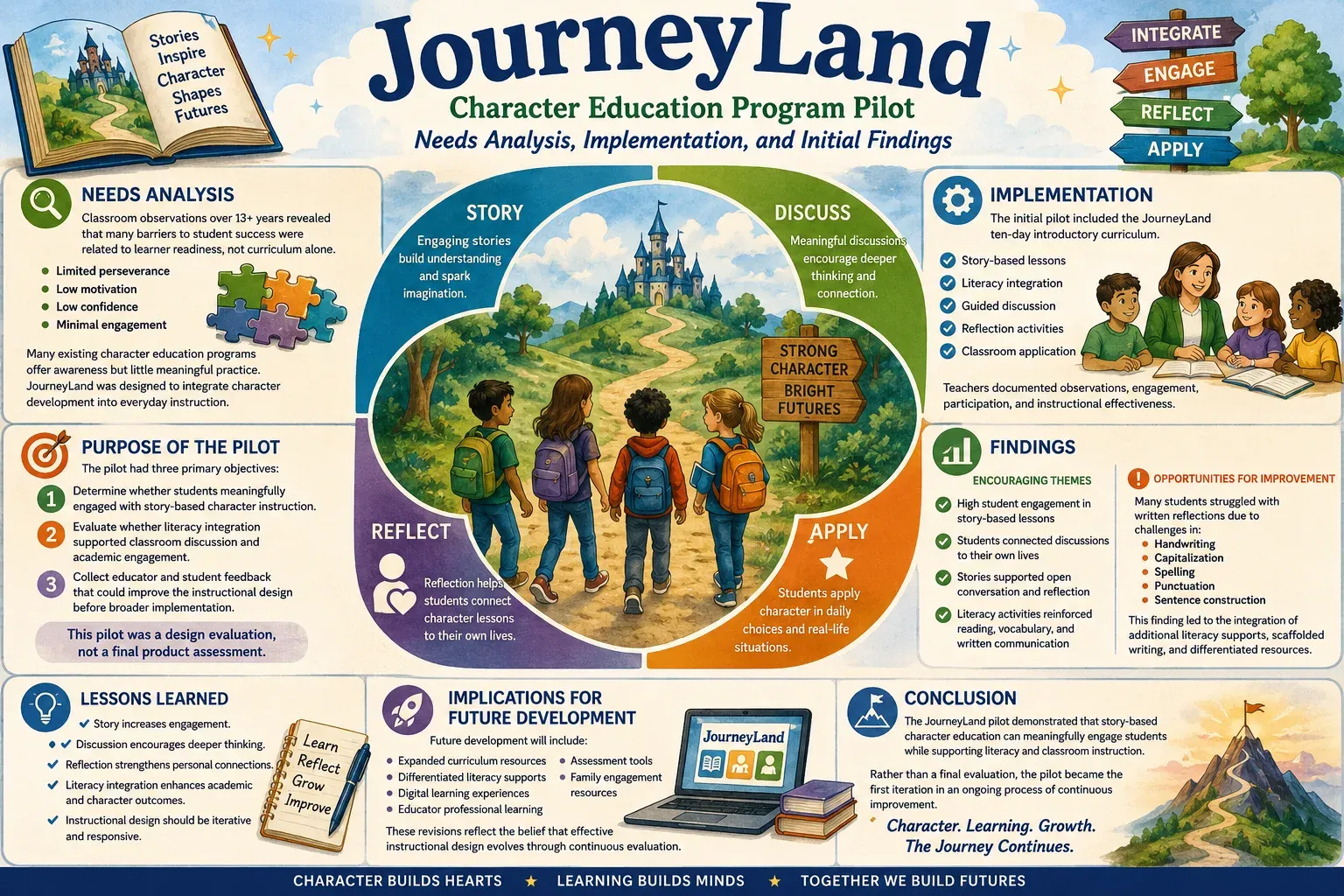
JourneyLand Character Education Program Pilot infographic — needs analysis, implementation, and initial findings.
Duration 10-day introductory curriculum
Sessions 90-minute sessions
Funding $5,000 NEA Foundation grant
SMART goals Understanding · Application · Connection

Needs Analysis

Classroom observations over 13+ years revealed that many barriers to student success were related to learner readiness — not curriculum alone.

  • Limited perseverance
  • Low motivation
  • Low confidence
  • Minimal engagement

Design response

  • Many existing programs offer awareness but little practice.
  • JourneyLand was designed to integrate character development into everyday instruction.

Purpose of the Pilot

This pilot was a design evaluation — not a final product assessment.

  • Determine whether students meaningfully engaged with story-based character instruction.
  • Evaluate whether literacy integration supported classroom discussion and academic engagement.
  • Collect educator and student feedback to improve instructional design before broader implementation.

Story · Discuss · Reflect · Apply

The core instructional cycle woven through every JourneyLand lesson.

Story

  • Engaging stories build understanding and spark imagination.

Discuss

  • Meaningful discussions encourage deeper thinking and connection.

Reflect

  • Reflection helps students connect character lessons to their own lives.

Apply

  • Students apply character in daily choices and real-life situations.

Implementation

The initial pilot included the JourneyLand ten-day introductory curriculum.

  • Story-based lessons
  • Literacy integration
  • Guided discussion
  • Reflection activities
  • Classroom application

Findings

Encouraging themes

  • High student engagement in story-based lessons.
  • Students connected discussions to their own lives.
  • Stories supported open conversation and reflection.
  • Literacy activities reinforced reading, vocabulary, and written communication.

Opportunities for improvement

  • Many students struggled with written reflections due to challenges in handwriting, capitalization, spelling, punctuation, and sentence construction.
  • This finding led to additional literacy supports, scaffolded writing, and differentiated resources.

Lessons Learned

  • Story increases engagement.
  • Discussion encourages deeper thinking.
  • Reflection strengthens personal connections.
  • Literacy integration enhances academic and character outcomes.
  • Instructional design should be iterative and responsive.

Implications for Future Development

  • Expanded curriculum resources
  • Differentiated literacy supports
  • Digital learning experiences
  • Educator professional learning
  • Assessment tools
  • Family engagement resources

Conclusion

The JourneyLand pilot demonstrated that story-based character education can meaningfully engage students while supporting literacy and classroom instruction. Rather than a final evaluation, the pilot became the first iteration in an ongoing process of continuous improvement.

  • Character. Learning. Growth. The journey continues.
Visual Summary

Research Report Infographic

The full pilot poster — needs analysis through conclusion — as shared in the JourneyLand program materials.

JourneyLand Character Education Program Pilot infographic covering needs analysis, implementation, findings, lessons learned, and future development.