


Mastery
Build strong foundations before moving forward. Clarify objectives, connect to prior knowledge, introduce new content, and model expert thinking.
Establish Understanding
Instructional design projects built for JourneyLand and K–8 learners.
View allJourneyLand ProgramThe full character education framework Character EducationStory, media & Purpose Squared
 CurriculumLesson design & classroom tools
 VAMSEngagement dashboards & badges
 AR / VRImmersive 3D learning worlds
 Game DesignPlayful quizzes & challenges
 Program ManagementCharter, scope & implementation

The Framework
MAPS Learning Framework
MAPS (Mastery, Application, Practice, and Scaffolding) is a learner-centered framework that provides a clear, flexible, and research-based sequence for designing meaningful learning experiences.
The MAPS Learning Framework is a nine-step instructional design model for interactive media. It sequences Mastery, Application, Practice, and Scaffolding so learners build understanding, apply knowledge, reflect, and extend learning — grounded in Gagné, ADDIE, and Gradual Release of Responsibility.
Mastery · Application · Practice · Scaffolding
Each pillar shapes a phase of the nine-step sequence — from building understanding to extending learning into new contexts.
Build strong foundations before moving forward. Clarify objectives, connect to prior knowledge, introduce new content, and model expert thinking.
Establish UnderstandingMove from guided collaboration to independent, authentic application — making learning stick through meaningful, real-world use.
Use & Apply LearningReinforce learning through feedback and reflection. Assess understanding and review to measure growth and inform the next step.
Reinforce & ReflectProvide adaptive support that grows with the learner — woven through every step, then gradually removed to encourage transfer.
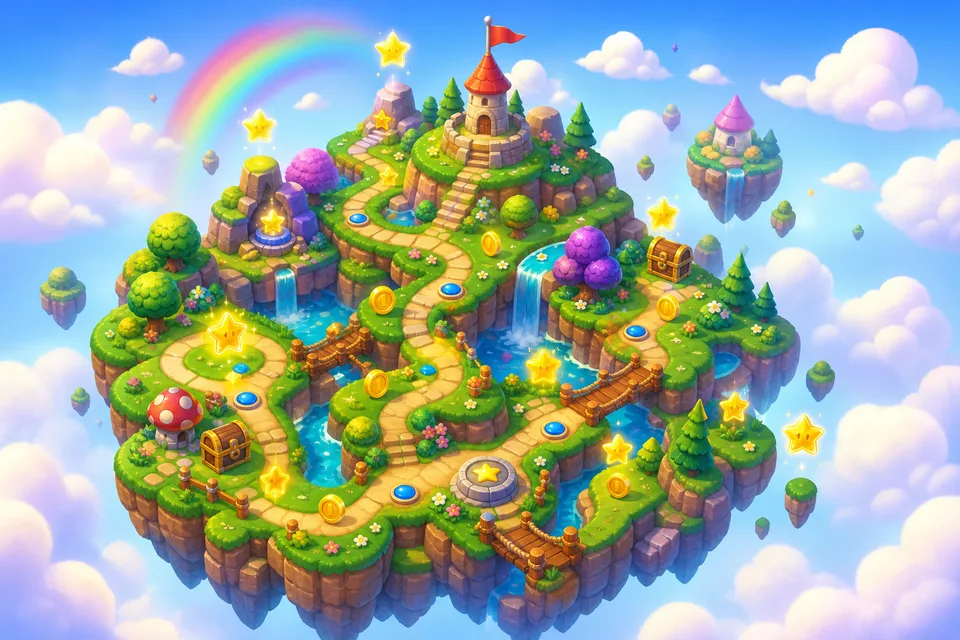
Support & ExtendFollow the trail — each stop moves the learner closer to growth.
↔ Scaffolding walks beside the learner at every stop on the trail
Build strong foundations and ensure understanding.
Establish UnderstandingApply knowledge in meaningful and relevant ways.
Use & Apply LearningReinforce learning through feedback and reflection.
Reinforce & ReflectProvide support that adapts as learners grow.
Support & ExtendThe MAPS cycle moves learners from clarity to transfer — with scaffolding woven through every phase. Extension at step nine informs the next lesson.
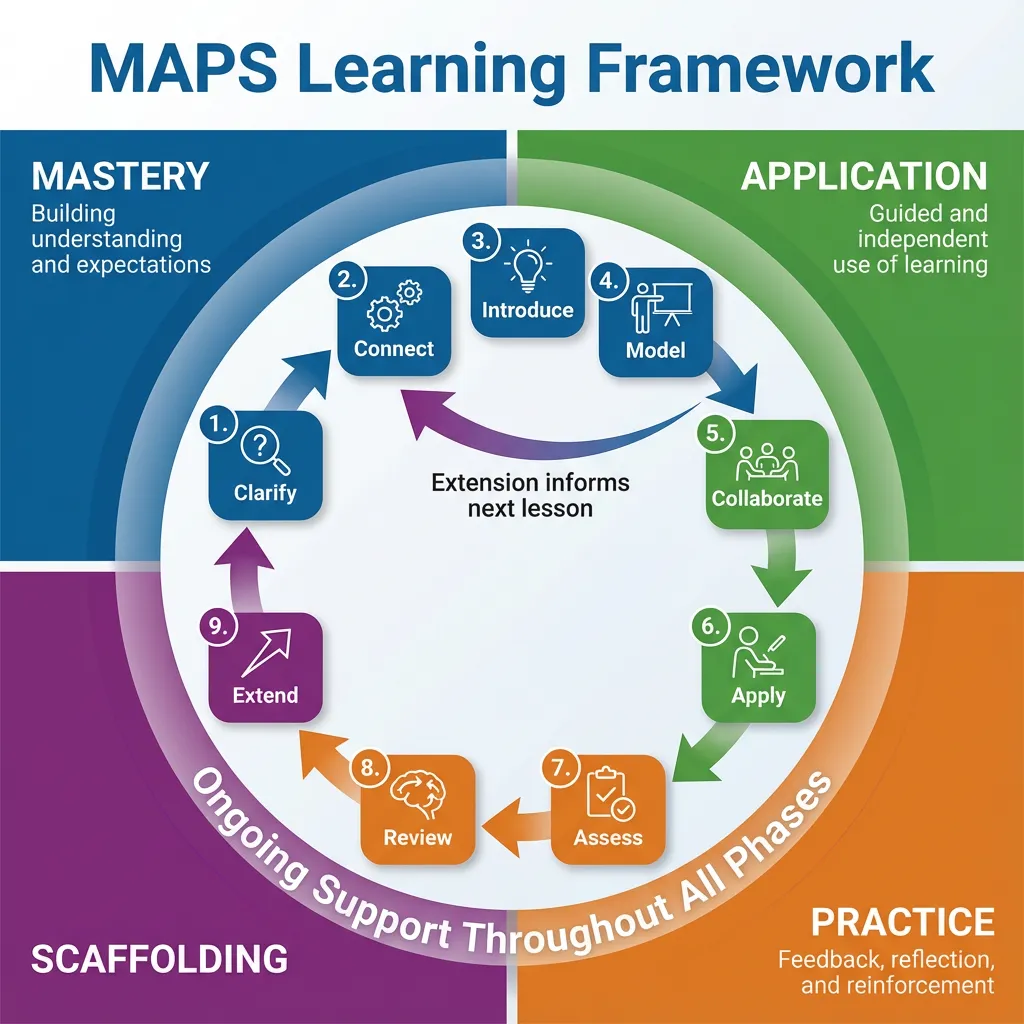
Each stop builds on the last — from clarity to transfer, with scaffolding at every phase.
Objectives & success criteria
Clarify learning objectives and success criteria.
Prior knowledge & context
Connect to prior knowledge and real-world experiences.
New concepts & skills
Introduce new concepts, skills, or information.
Expert thinking
Model thinking processes and strategies.
Guided practice
Collaborate and practice with guided support.
Authentic tasks
Apply learning through authentic and meaningful tasks.
Measure & inform
Assess to measure understanding and inform instruction.
Reflect & reinforce
Review and reflect on what was learned.
Transfer & grow
Extend learning and encourage transfer to new contexts.
MAPS Designed around learner needs, strengths, and real-world relevance.
Grounded in proven instructional design theories and best practices.
Easily adapted to different content areas, learners, and learning environments.
Focused on building character, knowledge, and skills that create lasting impact.
Pillar → Step mapping
Full academic treatment of the framework — methodology, theoretical grounding, and application for interactive learning media (ID-8930).
PDF export queued — paper source ready in client materials.
MAPS (Mastery, Application, Practice, and Scaffolding) is a nine-step instructional design model for interactive learning media. It provides a learner-centered sequence for building understanding, applying knowledge, reinforcing learning, and extending it into new contexts.
Mastery builds foundations and clarifies objectives. Application moves learners from guided collaboration to independent use. Practice reinforces learning through feedback and reflection. Scaffolding supports learners throughout every step of the cycle.
MAPS is grounded in Gagné's Nine Events of Instruction, the ADDIE model, and the Gradual Release of Responsibility — combining established instructional design theory with a practical sequence for interactive media.
The MAPS Learning Framework was developed by R.J. Morgan as part of doctoral coursework in instructional design and is applied across JourneyLand program materials and portfolio work.